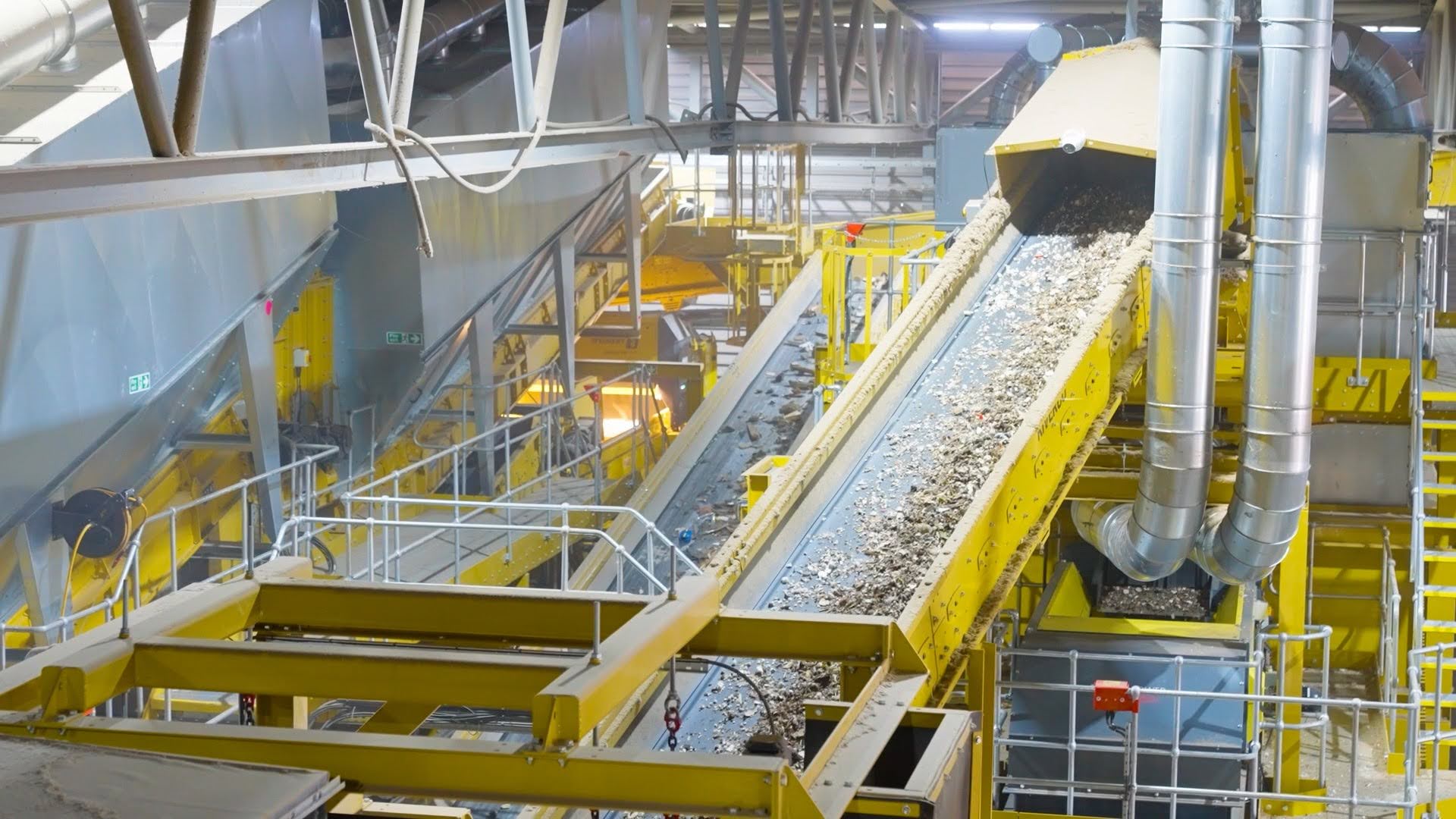
Dunmow Group is one of Essex's leading independent waste management and recycling companies. Over the last 35 years, the business has grown to serve the waste management needs of homeowners, small builders, national construction firms, local authorities and industrial businesses across the county.
In 2025, Dunmow Group invested £5 million in a new recycling plant at its advanced Materials Recovery Facility (MRF) in Chelmsford, enabling it to double its processing capacity to 600 tonnes of waste per day. That kind of investment demands protection from an equally significant increase in fire risk.
With that came more waste management plant running longer hours in higher-risk conditions. The business fitted Reacton automatic fire suppression to more than nine vehicles across all three sites, a proactive step to protect the people and equipment that keep operations running.
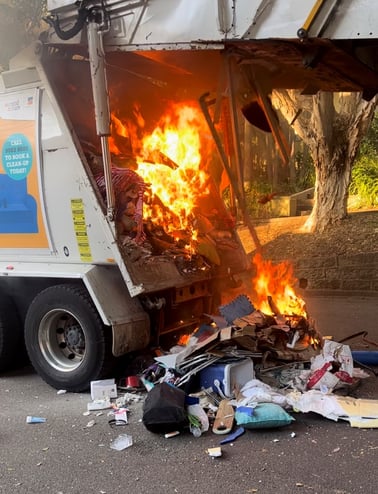
The waste that arrives at Dunmow Group's Chelmsford recycling facility is never predictable. What is predictable is the fire risk it brings with it.
Every day, skips full of mixed waste are tipped into the waste shed. Grabs, wheel loaders and shredders work within metres of highly combustible material, hour after hour. The machines rarely stop, and they run hot while working through debris and discarded waste.
Fire prevention has always been central to how Dunmow Group operates. Regular maintenance, inspections and housekeeping on all equipment were already standard practice.
But in recent years, the nature of the risk has changed, and it has changed rapidly.
Lithium-ion batteries are increasingly finding their way into the general waste stream. Disposable vapes, which currently have no official recycling route, are thrown into normal bins every day. E-scooter batteries and electric power tool batteries are ending up in household and commercial waste too.
Once these items are crushed or damaged during collection, handling or processing, they can ignite within seconds.
Dunmow Group's COO oversees waste processing operations across all three Essex sites and has seen the battery problem escalate first-hand.
"Batteries regularly end up in general waste where they shouldn't be."
The fire risk is not confined to one part of the operation. It runs through the entire waste process:
"Fire risk exists throughout the entire waste process. From collection vehicles and waste management plant through to the yard and processing equipment, we're constantly handling materials that can contain hidden ignition sources."
Any load could contain something ready to ignite. For a business with waste management plant operating around combustible material all day, that rising risk demanded a response.
-4.png?width=791&height=593&name=unnamed%20(1)-4.png)
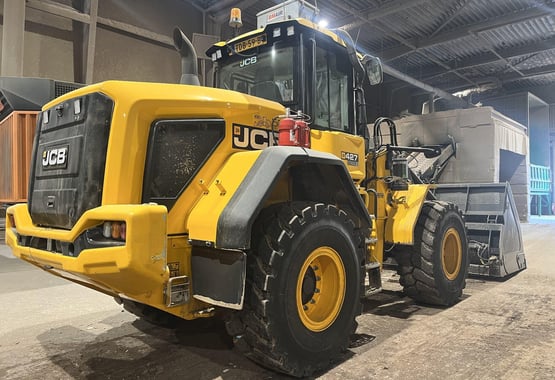
Dunmow Group's fleet includes Liebherr grabs, wheel loaders, and other heavy equipment that runs continuously inside the waste processing environment.
Fires develop in engine bays, hydraulic lines, and electrical compartments, and they develop fast.
The operator may not see the fire or smell it. By the time they notice, the fire may have already taken hold and begun to spread through the machine.
Manual intervention was too slow for this environment. A machine fire left unchecked can reach the surrounding waste and escalate into a full-site incident within minutes.
Dunmow Group needed a system that could detect a fire inside the machine at the earliest stage and suppress it automatically, before it spread any further.
"We wanted a solution that would automatically detect and suppress fires before they had the opportunity to develop into something much more serious."
The priorities were clear:
"A major machine fire doesn't just damage a machine; it can stop operations, affect customers, create environmental issues and place people at risk."
Dunmow selected Reacton as the clear provider of choice. Recognised as the UK waste sector's leading fail-safe solution, the system enjoys widespread global trust.
In the waste industry, seconds decide the outcome. A fire that starts in an engine bay or hydraulic compartment can spread through the machine before an operator even realises it is there. Once it reaches the combustible waste surrounding the machine, a single vehicle fire becomes a full-scale incident.
Dunmow Group needed a system that could act inside the machine, at the source, without waiting for someone to notice.
Reacton's automatic detection and suppression does exactly that, identifying a fire within the machine, at the earliest stage, and suppressing it before it has the chance to spread further.
"Even a small fire can quickly escalate into a major incident, so having an automatic system that works without human intervention gives us peace of mind and helps protect both our people and our investment."
With the decision made, the next question was how to fit the systems without taking machines out of operation.
When a business processes up to 600 tonnes of waste per day, taking a machine out of service has a direct cost. Dunmow Group needed an installation partner who could fit fire suppression systems without disrupting a live operation.
"Very professional from start to finish. The team understood our operation, communicated clearly throughout the process and worked efficiently to minimise disruption while the systems were installed."
The Reacton Trained Engineers scheduled the work around Dunmow Group's operating hours, keeping downtime to a minimum. The installation team's familiarity with the type of heavy equipment Dunmow Group runs gave the business confidence in the quality of the work from day one.
"The installation process was well organised, and it was clear the engineers were experienced and familiar with our equipment. They worked around our operating hours to minimise disruption, which was really important for a busy waste management business like ours."
Reacton fire suppression systems have now been fitted to more than nine of Dunmow Group's waste management vehicles across all three Essex sites.
What enters the waste stream is beyond anyone's control. Reacton protects the machines working in that environment.
The system is installed within the machine itself, monitoring the engine bay, hydraulic compartments, and electrical components where fires develop.
When it detects a fire, the suppression agent is released immediately, suppressing the fire inside the machine before it has the chance to spread further through the vehicle or reach the waste around it.
For operators inside the cab, that is the difference that matters. They can focus on the work in front of them, knowing that if something ignites below, the system is already responding.
"The biggest benefit is peace of mind. Knowing our waste management plant has automatic fire suppression allows operators to focus on the job while giving us confidence that if something were to happen, the system is designed to react immediately."
Dunmow Group can rest assured that the waste management fleet has protection in place and that the team is prepared for the worst while working to prevent it every day.
"The biggest impact is confidence."
For any waste operator weighing the cost of a suppression system against the cost of going without, Dunmow Group's view is straightforward. When compared to the immense fallout of a ruined machine, a compromised facility, weeks of operational downtime, customer disruption, insurance claims, and long-term reputational harm, the cost of a fire suppression system is remarkably small.
"The cost of a suppression system is small compared with the potential cost of losing a machine or our facility or, more importantly, putting people at risk. It's not just about replacing equipment; it's the downtime, customer disruption, insurance implications and protecting our reputation."
Fire suppression is one part of a wider investment Dunmow Group has made in safety, infrastructure and resilience. Since partnering with Reacton, the business has continued upgrading its recycling plant and expanding its waste plant fleet.
Fire suppression fitted across the operation now sits alongside that investment, protecting the equipment and the people the business depends on.
For customers who rely on Dunmow Group for consistent, uninterrupted waste management, that commitment to protection is part of the service.
"Investing in high-quality fire suppression demonstrates our commitment to operating responsibly and protecting the people, equipment and infrastructure our customers rely on every day."
Asked whether they would recommend Reacton to other operators in the waste sector, the answer was immediate.
"Absolutely. The quality of the system, combined with the professionalism of the team and their understanding of the waste industry, has made Reacton a trusted partner for us. They provide confidence that our fleet has the protection it needs in a high-risk environment."
Machine fires in the waste sector are increasing. The consequences of being unprotected go well beyond the cost of a single machine.
If your waste management plant, heavy equipment, or processing machinery operates in a high-risk environment, automatic fire suppression could be the protection your business is missing.
Get in touch with the Reacton team today to discuss how automatic fire suppression could protect your fleet, your people, and your business continuity.
.png?width=767&height=380&name=Untitled%20design%20(9).png)
.jpg?width=767&height=380&name=Reacton%20-%20Dual%20Agent%20-%20John%20Deere%20X9%201000(R).jpg)

Reacton HQ - UK and Europe
Appledale, 1 Eastways, Witham,
CM8 3YQ, UK
Reacton Americas
23335 N 18th Dr #140, Phoenix,
AZ 85027, United States
Reacton UAE
SIDRA Tower, Office 905,
Sheikh Zayed Road, Dubai, UAE


.svg)






No Comments Yet
Let us know what you think